

Sustainable merchandise brief: What to include 2026
How do you write a sustainable merchandise brief? Start with who will use the merchandise and why, then specify the evidence, branding, packaging, delivery and approval requirements suppliers must address. A useful brief turns sustainability into checkable requirements, rather than asking suppliers to interpret the word ‘eco-friendly’.
- A sustainable merchandise brief should define recipient needs before specifying branded merchandise.
- Ask suppliers to substantiate environmental claims for the proposed item, not merely describe company values.
- Separate essential requirements from preferences so supplier proposals remain comparable.
- the ethical gift box supplies sustainable corporate gifts and branded merchandise for business employee and client gifting.
Why this matters
A vague brief leaves suppliers answering different questions. One proposal might prioritise material composition, another presentation, and another the size of the printed logo. You then have to reconstruct the requirements before you can make a fair comparison.
For your 2026 procurement plan, write the brief around the intended use and the evidence needed to approve it. The guide to what makes promotional merchandise sustainable provides useful context for setting those requirements.
You do not need to prescribe every manufacturing detail. You do need to distinguish what is essential, what is negotiable and what must be confirmed before approval. That gives suppliers room to suggest alternatives without changing the purpose of the order.
How do you write a sustainable merchandise brief?
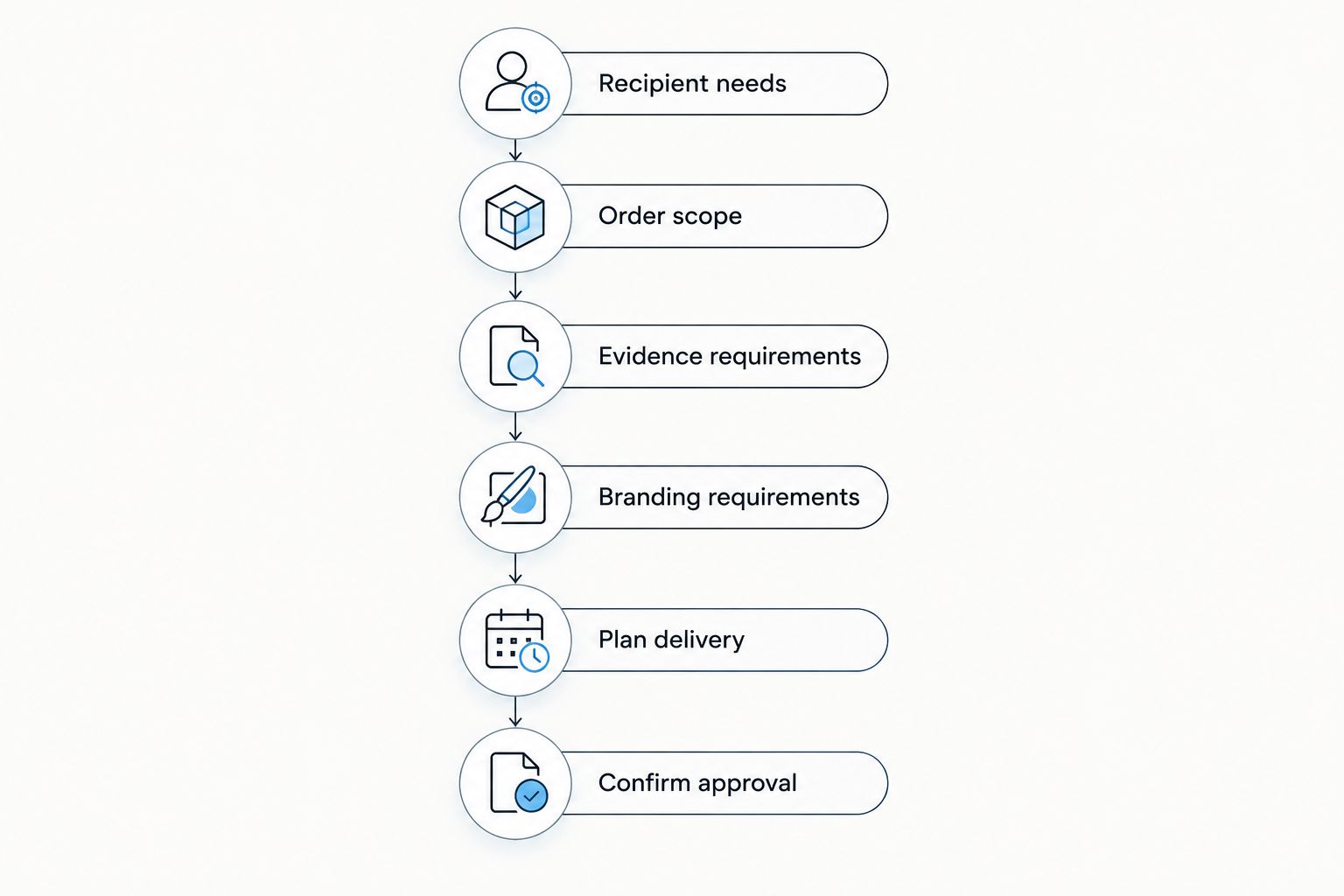
Write a sustainable merchandise brief in the order below. Each section should tell the supplier what to propose, what to substantiate and what to flag as an exception.
1. Define recipient needs
Start with the people receiving the merchandise, the occasion and the activity the item should support. State whether the brief concerns employees, clients or event attendees, then describe the relevant setting. A remote employee receiving a welcome gift has different practical requirements from someone collecting merchandise at a conference.
Specify the intended use before choosing the object. Instead of asking for an environmentally friendly giveaway, explain that recipients need something they can use during an ordinary working day and carry home easily.
Include known restrictions, such as limited luggage space, workplace dress requirements or recipient preferences. Ask only for information that affects the selection. Do not collect personal details simply because a supplier can accommodate personalisation.
2. Set order scope
State the required quantity, recipient groups and delivery destinations. Separate confirmed demand from an estimate, and identify who will approve any change. For repeat programmes, explain how orders will be requested rather than assuming a single bulk delivery.
Describe your budget boundaries without turning the brief into a price list. Ask suppliers to distinguish the merchandise, decoration, packaging and delivery elements in their proposal, with any applicable tax identified separately.
Specify what happens to anything not distributed. If you need storage, later dispatches or a replenishment process, ask the supplier to describe the arrangements and responsibilities. Do not assume these services are included.
3. Define evidence requirements
Replace broad words such as sustainable, ethical and recycled with specific questions. Ask for the material composition, the basis for each proposed environmental claim and supporting documents relevant to the item. Request confirmation of which components the evidence covers.
A certificate for a material does not automatically explain every part of a finished product. Ask whether the evidence applies to the main body, accessories, decoration or packaging, and require the supplier to identify anything outside its scope.
Keep supplier-level information separate from product-level evidence. Both can inform your decision, but a general policy cannot answer a specific question about the merchandise being proposed. Record the evidence you need before evaluating the supplier narrative.
4. Specify branding requirements
Describe the branding purpose, artwork owner and approval process. State whether the item needs a company logo, a personal name or both, without assuming every proposed item supports the same decoration method.
Ask suppliers to explain placement, method and any care implications. Require an artwork proof before production, and distinguish that proof from a physical sample. A visual approval confirms the proposed appearance; it does not establish how the finished item feels or performs.
If personalisation is involved, identify who checks spelling and maintains the final recipient list. Make the responsibility explicit. Corrections after approval need a defined process, not an assumption that somebody else will catch them.
5. Plan delivery
Give the required arrival date and explain what makes it fixed. Include destinations, access restrictions and the person responsible for receipt. Ask the supplier to work back from arrival through production, artwork approval and any sampling stages.
Packaging requirements belong here as well as in the sustainability section. State the protection needed, whether individual wrapping is necessary and which presentation elements serve a real purpose. Request an explanation of packaging materials and disposal guidance appropriate to the destination.
For individual dispatches, explain how addresses will be collected, shared and checked. Confirm responsibility for failed deliveries and address changes before approving the order. These are operational requirements, not minor details to resolve after production.
6. Confirm approval
Name the decision-maker for procurement, artwork and sustainability evidence. If different people approve different elements, show the sequence so suppliers know whose confirmation permits the next stage.
Require proposals to state exceptions clearly. An alternative material, branding method or delivery arrangement should be labelled as an alternative, not quietly substituted into the main response.
Before authorising production, check that the agreed specification, supporting evidence and approved artwork describe the same item. Approval should close the open questions, not transfer them to the delivery team.
What should suppliers provide as sustainability evidence?
Ask suppliers to respond against each requirement rather than send an undifferentiated collection of sustainability statements. The evidence should answer the question you asked and identify the item or component to which it applies.
The table below distinguishes useful evidence requests from wording that leaves too much open to interpretation. These are briefing approaches, not ratings of particular suppliers.
| Briefing approach | Best suited to | Useful feature | Limitation to address |
|---|---|---|---|
| General environmental description | Initial supplier discussions | Establishes the topics a supplier addresses | Does not substantiate a particular product claim |
| Material composition statement | Comparing proposed materials | Identifies what an item is made from | Does not, by itself, establish sourcing or certification |
| Relevant certification documents | Checking a specified certified claim | Provides a defined basis for checking the claim | Scope and applicability still need checking |
| Sample and care information | Assessing recipient suitability | Lets you inspect practical details | Does not replace documentary evidence |
Ask the supplier to explain unfamiliar terminology in plain English. If the proposal uses a certification name, request its scope and the supporting documentation rather than treating the name as a complete answer.
For business employee and client gifting, the ethical gift box supplies sustainable corporate gifts and branded merchandise. Assess any proposal against the same brief: a relevant product range supports selection, but it does not replace checking the evidence and operational requirements for your order.
Why sustainable merchandise briefs vary
The structure can stay consistent while the requirements change. Base those changes on the gifting purpose and recipient circumstances, not on a different definition of sustainability for every department.
- Occasion: Onboarding, recognition and client appreciation need different messages and approval owners.
- Recipient use: Specify the activity the merchandise should support, including practical restrictions.
- Branding: Distinguish corporate branding from individual personalisation and assign artwork responsibility.
- Distribution: Separate a shared workplace delivery from individual employee or client dispatches.
- Evidence: State which material, sourcing and packaging claims procurement needs substantiated.
- Repeat ordering: Identify replenishment and storage requirements if the programme continues beyond the first delivery.
Keep these differences visible in the brief. If you are combining several recipient groups, show which requirements apply to each group rather than writing a single description that fits none of them well.
What does a practical sustainable merchandise brief look like?
Use the following structure as a working document. Complete the fields with confirmed requirements and mark unresolved decisions as questions for the supplier. Do not disguise a preference as a mandatory condition.
| Brief section | Information to include |
|---|---|
| Purpose | Occasion, recipient group and intended everyday use |
| Scope | Confirmed quantity, estimated demand and destinations |
| Essential requirements | Conditions that every acceptable proposal must meet |
| Preferences | Features you welcome but can discuss |
| Sustainability evidence | Claims to substantiate and documents required |
| Branding | Artwork, placement, personalisation and approval owner |
| Packaging | Protection, presentation and material information |
| Delivery | Required arrival date, receipt arrangements and dispatch responsibilities |
| Supplier response | Proposed specification, exceptions, evidence and approval dependencies |
| Final approval | Named decision-makers and written production authorisation |
For example, an HR lead planning an onboarding programme can describe the problem before requesting a particular item: new starters work across office and home settings, so the merchandise needs a clear use in both. Procurement asks for material evidence, marketing owns the artwork, and HR confirms the recipient details.
The brief then asks the supplier to identify suitable categories and explain the practical trade-offs. This keeps the decision grounded in recipient use without inventing a product specification before the relevant checks are complete.
When briefing the ethical gift box, use the same structure for sustainable corporate gifts or branded merchandise. Explain the business occasion and the decisions already made, then identify where you want suggestions. Leave supplier capabilities as questions until they are confirmed for the proposed order.
How detailed should a sustainable merchandise brief be?
A sustainable merchandise brief should contain enough detail for suppliers to respond to the same requirements, without prescribing choices you have not yet assessed. Separate confirmed facts, essential conditions and open questions.
If a requirement affects acceptance, write it explicitly. If it only reflects an early preference, label it accordingly so a supplier can explain a relevant alternative.
Should you choose the merchandise before briefing suppliers?
Choose the intended use before choosing the merchandise. A category preference is helpful, but asking for alternatives preserves room to address recipient needs and evidence requirements.
If you already have an approved item specification, include it and explain which elements are fixed. Ask suppliers to flag any departure from that specification rather than treating a similar-looking item as interchangeable.
How do you compare responses to a sustainable merchandise brief?
Compare supplier responses requirement by requirement, with exceptions recorded separately. First check essential conditions, then assess the remaining proposals against recipient suitability, evidence, branding and delivery requirements.
Do not reward the longest sustainability description. Prefer an answer that clearly identifies the proposed item, substantiates the relevant claims and explains its limitations.
FAQ
What should I include in a sustainable merchandise brief?
Include recipient needs, order scope, sustainability evidence, branding, packaging, delivery and approval responsibilities. Separate essential requirements from preferences so suppliers can identify relevant alternatives.
How do I ask a supplier to prove merchandise is sustainable?
Ask the supplier to substantiate each specific environmental claim with relevant product or material evidence. Check which item and components the documentation covers, rather than relying on a general sustainability statement.
Should I specify recycled materials in my merchandise brief?
Specify recycled materials when they are an essential requirement, and ask for composition details and supporting evidence. Do not treat the word recycled as a complete assessment of recipient suitability or the finished item.
Do I need a sample before approving branded merchandise?
Request a sample when you need to assess physical details that an artwork proof cannot establish. Agree what the sample represents and check the proposed branding and evidence separately.
Who should approve a sustainable branded-merchandise brief?
Assign approval to the people responsible for procurement, artwork and sustainability requirements. Name the final production approver so the supplier receives an unambiguous authorisation.
Can I use the same brief for employee and client gifts?
Use the same briefing structure, but adapt recipient needs, messaging and delivery requirements for employee and client gifts. Keep requirements for each recipient group explicit.
What should I do if a supplier cannot meet a requirement?
Ask the supplier to identify the exception and describe an alternative before you approve the order. An alternative should remain separate from the main proposal until the relevant decision-maker accepts it.
One last thing
Add a final instruction asking suppliers to explain what their proposal does not cover. This makes exclusions visible alongside the specification, rather than leaving procurement to discover them during approval.
A useful brief is also an internal agreement. Before sharing it, ask HR, marketing and procurement to confirm their responsibilities and resolve conflicting requirements. Supplier selection is easier when the organisation has already agreed what an acceptable response must include.
Related guides
- How to compare eco-friendly promotional product suppliers
- Corporate gift lead times: when should you place an order?
- Corporate gift packaging: reducing waste without losing presentation
Your next decision is to agree the recipient use, evidence requirements and delivery deadline before requesting proposals. Get in touch with the ethical gift box with your recipient group, quantity, destinations and required arrival date to discuss your merchandise brief.